Introduction
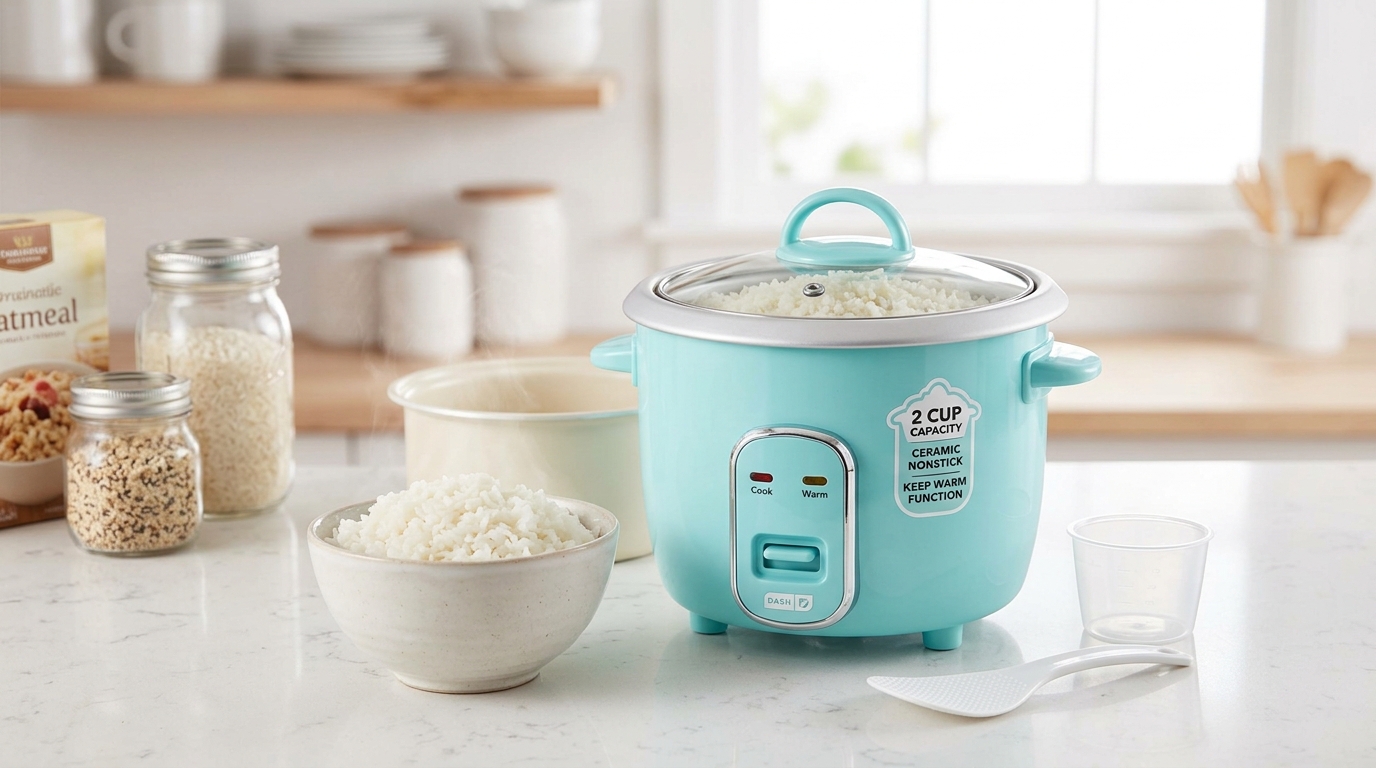
Not every kitchen setup calls for a large appliance, and for people cooking primarily for themselves, a compact option like the Dash Mini Rice Cooker often makes more practical sense than a standard family-size unit. Built around a 2-cup capacity with a removable ceramic nonstick pot, available in an aqua finish, this small rice cooker is marketed specifically as a rice maker for one, with a keep-warm function and the ability to prepare oatmeal, quinoa, and other grains beyond just rice.
This article takes a closer look at what the Dash Mini Rice Cooker actually offers, the different ways it tends to be used in daily cooking, who it’s generally best suited for, and a handful of practical points worth considering before choosing one. As with any kitchen appliance, understanding the specifics helps clarify whether it fits a particular lifestyle or kitchen setup.
Key Features
Compact 2-Cup Capacity
The defining trait of this appliance is its small size. A 2-cup capacity places it firmly within the personal or single-serving category of rice cookers, considerably smaller than standard family-size models that often range from 6 to 10 cups. This scale is generally intended for individuals cooking for themselves rather than for larger groups.
Removable Ceramic Nonstick Pot
The inner cooking pot uses a ceramic nonstick coating and is designed to be removable, which serves two main practical purposes. First, it allows for easier serving directly from the pot. Second, it simplifies cleanup, since the pot can be washed separately from the base unit, which generally should not be submerged in water.
Keep Warm Function
A built-in keep-warm setting is included, which typically activates automatically once the cooking cycle finishes. This is intended to maintain a safe serving temperature for a period of time after cooking, which can be useful for those who don’t eat immediately once the rice or grains are done.
Versatility Beyond Rice
While marketed primarily as a rice cooker, this appliance is also described as being capable of preparing oatmeal, quinoa, and other grains. This kind of added versatility can make it a more frequently used appliance for those who regularly rotate between different grain-based meals rather than relying solely on rice.
Compact, Space-Saving Design
Given its small 2-cup capacity, the overall footprint of the appliance tends to be considerably smaller than standard rice cookers, making it easier to store in limited cabinet space or leave out on a counter without taking up much room.
Simple, Straightforward Operation
Appliances in this category, including the Dash Mini, are generally designed with simple, easy-to-understand controls rather than extensive digital programming, which tends to appeal to users who want a quick, no-fuss way to prepare small portions of food.
How It Can Be Used
Given its compact size and grain versatility, this appliance tends to be used in a fairly specific set of everyday situations.
Single-serving rice preparation. The most straightforward use is preparing a single portion of rice, which is generally the core function this appliance is designed around.
Morning oatmeal preparation. Since the appliance is noted as being capable of cooking oatmeal, some users incorporate it into a morning routine as a simple way to prepare a single serving without needing a stovetop pot.
Quinoa and other grain bowls. Beyond rice and oatmeal, the appliance can generally be used to prepare quinoa or similar grains, which can then be used as a base for grain bowls or simple side dishes.
Dorm rooms and small kitchens. Due to its compact footprint, this type of appliance is often used in dorm rooms, small apartments, or offices where a full-size rice cooker would be impractical or unnecessary.
Meal prepping for one. Some individuals use small rice cookers like this one as part of a regular routine for preparing single portions of grains to pair with other prepped ingredients throughout the week.
Travel or secondary living spaces. Given the compact size, this kind of appliance is sometimes used in vacation homes, RVs, or as a backup unit for smaller cooking tasks outside a primary kitchen.
Who It May Be Suitable For
This type of appliance tends to appeal to a fairly specific group of users, including:
- Individuals living alone who don’t need the capacity of a standard rice cooker and prefer a smaller, more manageable option.
- College students in dorms or shared housing situations with limited kitchen space and appliance restrictions.
- People in small apartments or studios where counter and storage space is limited.
- Those who eat a variety of grains, such as oatmeal or quinoa, and want a single appliance capable of handling more than just rice.
- Anyone looking for a simple, low-maintenance appliance for small portions without the complexity of a larger multi-function cooker.
On the other hand, households cooking for two or more people on a regular basis would likely find a 2-cup capacity too limiting, and a standard or mid-size rice cooker would generally be a more practical choice in that case.
Important Things to Consider
Before choosing a compact rice cooker like this one, a few practical points are worth thinking through.
Capacity limitations. A 2-cup appliance is only suitable for small, individual portions, and it’s important to have realistic expectations about how much food it can prepare in a single cycle, particularly for anyone hoping to cook for more than one person or batch cook larger quantities.
Ceramic coating care. Ceramic nonstick coatings generally benefit from gentle cleaning methods and the use of non-abrasive utensils to help preserve the surface over time.
Cooking time variability by grain type. Since the appliance is used for rice, oatmeal, and quinoa, cooking times and liquid ratios can vary between these different foods, so it may take some initial experimentation to get consistent results across different recipes.
Basic feature set. Compact rice cookers in this category generally rely on simple, single-setting operation rather than the more advanced programmable features found in larger, higher-end models, which is worth keeping in mind for those who want more automated control.
Accessory and component storage. While the removable pot adds convenience for cleaning, it also means there is an additional component to store and keep track of separately from the base unit.
Comparison of General Categories
Rice cookers can generally be grouped into a few broad categories based on capacity and feature set.
Personal or mini rice cookers, such as the Dash Mini, are generally designed for capacities around 1 to 3 cups of dry rice, aimed at individuals or very small households.
Standard family-size rice cookers typically range from 4 to 8 cups of dry rice capacity, suited to average households cooking for three to six people regularly.
Large-capacity rice cookers, often exceeding 10 cups, are generally intended for bigger families, meal prep purposes, or households that frequently host larger groups.
Basic versus advanced technology represents another distinction within the category, with simple models like this one relying on straightforward on/off operation, while more advanced fuzzy logic or programmable rice cookers offer automated adjustments and additional settings for different grain types.
Choosing between these categories generally comes down to household size, available kitchen space, and how much versatility or automation a person expects from their appliance.
Frequently Asked Questions
Is a 2-cup rice cooker enough for a full meal? For a single person, a 2-cup capacity is often sufficient to prepare enough rice, oatmeal, or quinoa for one meal, though it would not be adequate for multiple servings or larger households in a single cooking cycle.
Can this appliance cook oatmeal and quinoa the same way as rice? While the appliance is capable of preparing these different foods, cooking times and liquid ratios generally vary by grain type, so it’s worth referring to specific guidance or recipes for each type of food being prepared.
Is the ceramic pot dishwasher safe? Dishwasher compatibility can vary, and it’s generally recommended to check the specific care instructions included with the unit, since ceramic nonstick surfaces sometimes benefit from hand washing to help preserve the coating over time.
How long does the keep-warm function typically last? Keep-warm duration can vary by model, and it’s worth checking the specific product details for this appliance, though it’s generally advisable not to leave food on warm for excessively long periods for food safety reasons.
Does this rice cooker turn off automatically after cooking? Many compact rice cookers, including basic models like this one, are designed to switch to a keep-warm setting automatically once the primary cooking cycle finishes, though it’s best to confirm this specific behavior through the included instructions.
Is this a good option for meal prepping multiple days at once? Given its small 2-cup capacity, this appliance is generally better suited to preparing single portions rather than larger batches intended to last several days, though it can still be used repeatedly throughout the week for fresh, small portions.
Conclusion
The Dash Mini Rice Cooker fills a clear niche within the broader rice cooker category, offering a compact, single-serving solution built around a 2-cup capacity, a removable ceramic nonstick pot, and the ability to prepare rice, oatmeal, and quinoa beyond standard rice cooking alone. For individuals, students, or anyone in a smaller living space who doesn’t need a full-size appliance, this type of product offers a straightforward and space-efficient way to prepare a variety of grain-based meals.
At the same time, its limited capacity makes it a poor fit for households cooking for multiple people on a regular basis. As with most compact kitchen appliances, the right choice ultimately depends on individual portion needs, available kitchen space, and how often different types of grains are part of a regular diet.