Introduction
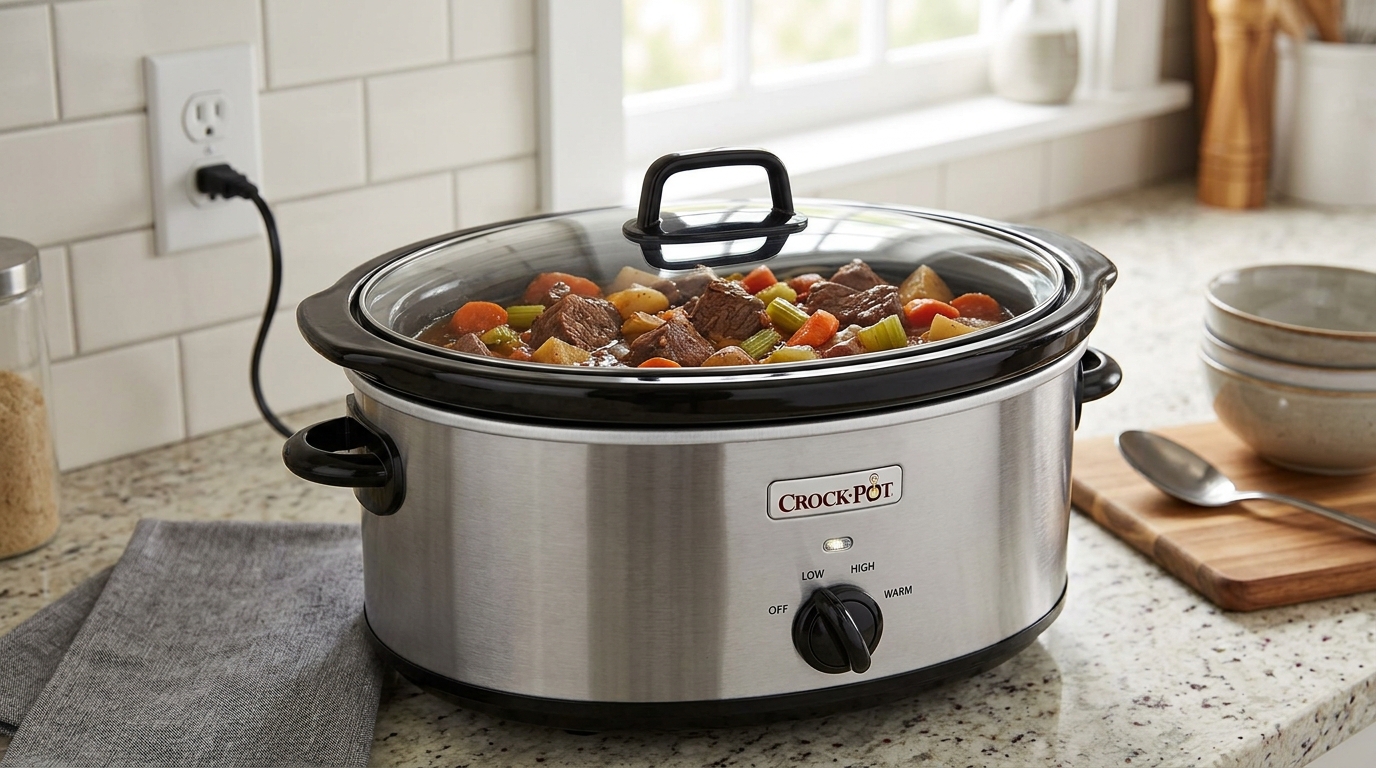
For many home cooks, the slow cooker remains one of the most reliable kitchen tools available, especially for households that need to prepare large meals without spending hours actively standing over a stove. The Crock-Pot 7-Quart Manual Slow Cooker is designed with exactly this kind of household in mind. With a stainless steel exterior, a removable stoneware insert, and a capacity built to serve eight or more people, this appliance is positioned as a practical solution for family dinners, meal prepping, and gatherings where a large volume of food needs to be prepared with minimal supervision.
This article takes a closer look at what this slow cooker offers, how it can be used in different cooking situations, who might find it useful, and what factors are worth thinking about before adding it to a kitchen. The goal here is not to push a purchase decision, but to lay out the practical details so readers can decide for themselves whether this type of appliance fits their needs.
Key Features
Large 7-Quart Capacity
The defining characteristic of this model is its size. A 7-quart capacity is generally considered large in the slow cooker category, and it is often marketed toward families or anyone who regularly cooks in bulk. According to the product description, it is built to serve eight or more people and can accommodate a roast weighing up to six pounds. This makes it suitable for whole chicken preparations, larger cuts of beef or pork, big batches of chili or stew, and multi-day meal prepping.
Manual Control Dial
Unlike programmable slow cookers that come with digital timers and multiple pre-set cooking modes, this is a manual model. It typically includes basic heat settings, such as low, high, and warm, controlled through a simple dial. For many users, this kind of straightforward control panel is appealing because there are fewer components that could potentially malfunction, and the operation is easy to understand without reading through a lengthy manual.
Removable Stoneware Insert
The stoneware insert is designed to be removable, which serves a few practical purposes. First, it allows the pot to go from stovetop or oven-adjacent use directly to the table for serving, without needing to transfer food to another dish. Second, it simplifies cleaning, since the insert can be taken out and washed independently of the heating base, which should never be submerged in water.
Warming Setting
A “keep warm” function is included, which is a common feature in slow cookers designed for entertaining or family meals. This setting is generally used after the cooking cycle finishes, allowing food to stay at a safe serving temperature without continuing to cook further. This can be particularly useful during gatherings where guests may not all sit down to eat at the same time.
Dishwasher-Safe Components
The stoneware insert and lid are noted as dishwasher safe, which can be a meaningful convenience factor for households that prefer not to hand-wash bulky cookware. This is worth double-checking against the specific care instructions included with the unit, since manufacturer guidance can vary slightly depending on the exact model version.
Stainless Steel Exterior
The stainless steel design is generally chosen for both aesthetic and practical reasons. It tends to blend well with a range of kitchen styles, from traditional to more modern setups, and stainless steel surfaces are often easier to wipe down compared to some other finishes.
How It Can Be Used
A slow cooker of this size opens up a fairly wide range of cooking possibilities. Below are some of the most common ways a 7-quart model like this tends to be used in everyday kitchens.
Whole roasts and large cuts of meat. Because the unit is built to accommodate up to a six-pound roast, it works well for pot roasts, whole chickens, pork shoulders, and similar large cuts that benefit from long, slow cooking at low temperatures.
Soups, stews, and chilis in bulk. The larger capacity makes it easier to prepare big batches of soup or chili, which can then be portioned out for leftovers or frozen for later use. This is especially useful for households trying to reduce the amount of time spent cooking on a daily basis.
Meal prepping for the week. Some users rely on slow cookers specifically for batch cooking on weekends, preparing multiple meals’ worth of protein or grains that can be stored and reheated throughout the week.
Entertaining and potlucks. Given the size and the built-in warming function, this type of slow cooker is often used for gatherings, potlucks, or holiday meals where food needs to stay warm for an extended period while guests serve themselves at different times.
Basic one-pot meals. Beyond large cuts of meat, a slow cooker this size can also handle casseroles, bean dishes, pulled pork, and other one-pot recipes that benefit from extended, low-temperature cooking.
Who It May Be Suitable For
This type of appliance tends to appeal to a fairly specific range of households and cooking styles, including:
- Larger families who regularly need to prepare meals for four or more people and want a way to cook in bulk without constant supervision.
- Meal preppers who set aside time once or twice a week to prepare multiple meals in advance.
- People who host gatherings and need a reliable way to keep a large quantity of food warm and ready to serve over several hours.
- Individuals who prefer simple appliances without digital interfaces, since the manual dial keeps the operation straightforward.
- Cooks looking to reduce active cooking time, since slow cookers generally require far less hands-on attention compared to stovetop or oven cooking.
On the other hand, this may not be the ideal fit for individuals or couples with smaller households, since a 7-quart capacity is considerably larger than what is typically needed for one or two servings. In those cases, a smaller 2 to 4-quart model might be more practical and easier to store.
Important Things to Consider
Before choosing any slow cooker, there are a few practical factors worth thinking through.
Kitchen counter and storage space. A 7-quart unit is fairly large, and it’s worth measuring available counter or cabinet space beforehand to make sure it fits comfortably, particularly in smaller kitchens.
Manual versus programmable functionality. Since this model uses manual controls rather than a digital timer, it does not automatically switch to a “keep warm” mode after a set cooking time unless manually adjusted. This is worth keeping in mind for anyone who may be away from home for long stretches during the cooking process.
Household size versus appliance size. Buying a slow cooker that is significantly larger than what a household regularly needs can lead to underuse. It’s generally a good idea to match the appliance size to typical cooking habits rather than choosing the largest available option by default.
Care and cleaning instructions. While the stoneware components are generally dishwasher safe, the heating base itself typically is not, and should only be wiped down with a damp cloth. Following the specific care guidance provided with the unit helps maintain its longevity.
Recipe adaptation. Recipes designed for smaller slow cookers may need slight adjustments in cooking time or liquid quantity when scaled up for a 7-quart model, since a larger volume of food can behave differently during the cooking process.
Comparison of General Categories
Slow cookers on the market generally fall into a few broad categories, each suited to different needs.
Small capacity models (1.5 to 3 quarts) are typically designed for singles, couples, or side dishes like dips and sauces. They take up minimal space but are not practical for larger family meals.
Mid-size models (4 to 6 quarts) tend to be the most common choice for average-sized households, offering a balance between capacity and counter space requirements.
Large capacity models (7 quarts and above), like the one discussed in this article, are generally aimed at bigger families, meal preppers, or anyone who frequently cooks in bulk or hosts gatherings.
Manual versus programmable models represent another key distinction across the category. Manual models, such as this one, rely on simple dial controls, while programmable versions include digital timers, multiple pre-set cooking modes, and sometimes app connectivity. Manual models tend to be simpler and often more budget-friendly, while programmable versions offer more automated convenience for users who may not be home to manually switch settings.
Each category serves a different purpose, and the right choice generally comes down to household size, cooking habits, and how much hands-on control a person prefers over their appliance.
Frequently Asked Questions
Is a 7-quart slow cooker too big for a small household? It can be, depending on cooking habits. For one or two people, a smaller model in the 2 to 4-quart range is often more practical, though a larger model can still be useful for those who like to batch cook and freeze leftovers.
Can this slow cooker go in the oven? Slow cooker stoneware inserts are generally not designed for use in a conventional oven unless specifically stated by the manufacturer. It’s best to check the included manual for guidance on this.
How long does food typically take to cook in a slow cooker this size? Cooking times vary widely depending on the recipe, but general guidance suggests low settings often range from six to ten hours, while high settings tend to fall between three and six hours. Specific recipes will usually include more precise timing.
Is the stoneware insert heavy? Larger stoneware inserts, particularly at 7-quart capacity, do tend to be heavier than smaller models, which is worth considering for anyone who may have difficulty lifting or maneuvering bulkier cookware.
Does the warming setting continue to cook the food? The warming setting is generally designed to maintain temperature rather than continue active cooking, though it’s still advisable to avoid leaving food on warm for excessively long periods for food safety reasons.
Can this be used for desserts or baked goods? Some slow cooker recipes do include desserts, such as bread pudding or certain cake recipes, though this typically depends on the specific recipe and may require adjustments for a larger capacity unit.
Conclusion
The Crock-Pot 7-Quart Manual Slow Cooker is built around the idea of simplicity and capacity, offering a straightforward way to prepare large meals with minimal daily effort. Its size makes it well suited to bigger households, meal preppers, and anyone who regularly hosts gatherings, while the manual dial keeps the operation uncomplicated for those who prefer not to deal with digital settings. At the same time, its larger footprint means it may not be the most practical choice for smaller households or limited kitchen spaces.
As with any kitchen appliance, the right choice ultimately depends on individual cooking habits, household size, and available storage. For those who regularly cook in bulk or want an easier way to manage family meals, this type of slow cooker is worth further research.